
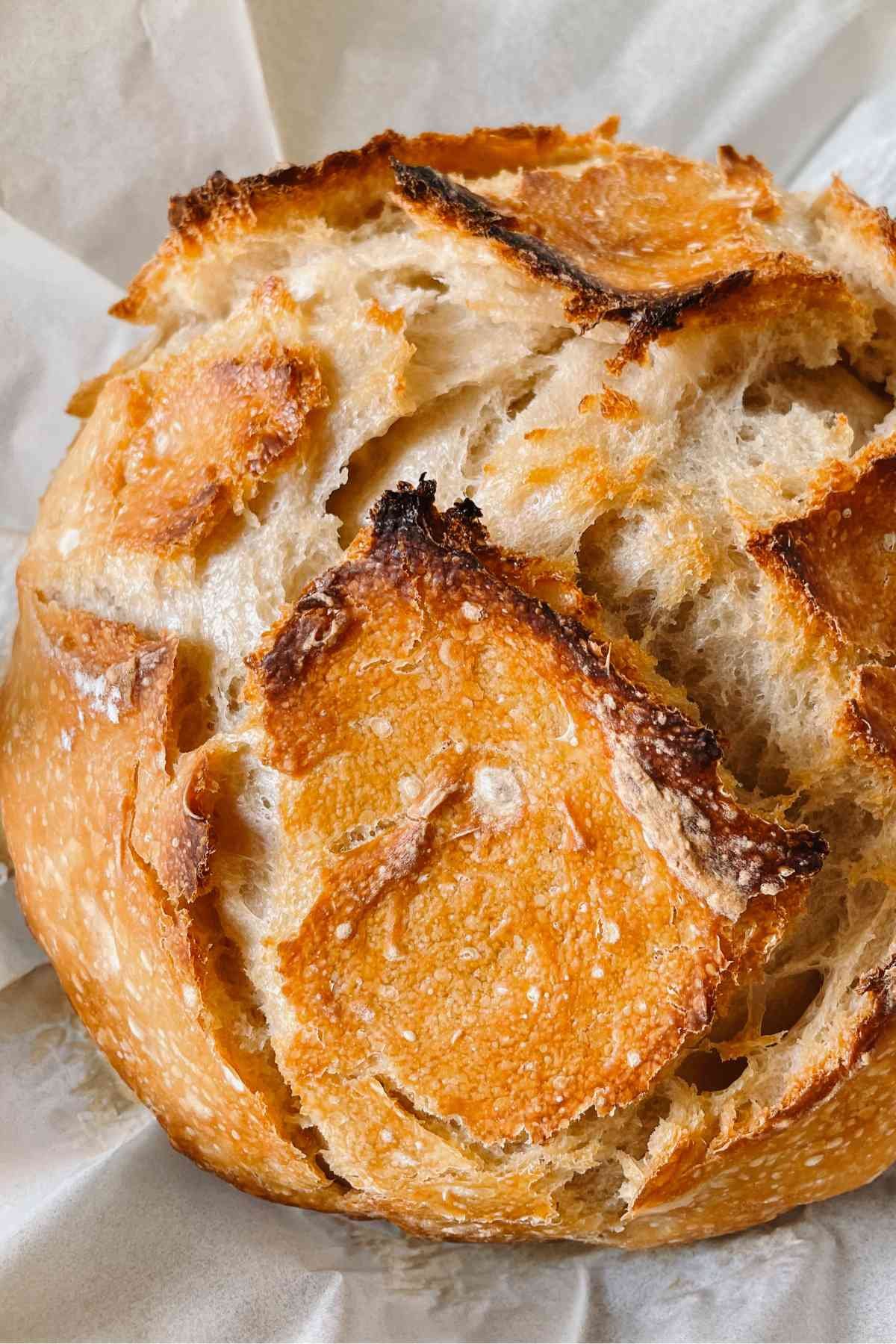
Unloaf Sourdough Bread: The easiest sourdough ever — works with any stage of starter, no stretch-and-folds required, no refrigerator ferment time — and it still turns out perfect every single time! This “Unloaf Sourdough” recipe has become a favorite because it removes the complicated parts of sourdough baking while still giving you beautiful, flavorful bread with a chewy interior and golden crust.
Yield: 2 medium loaves
Prep time: 20 minutes
Rise/Fermentation time: 7–10 hours
Bake time: 45–50 minutes per loaf
Ingredients
- 1000g bread flour (about 8 cups)
- 750g warm water (about 3¼ cups)
- 200g sourdough starter (fed, unfed, active, or slightly past peak)
- 20g salt (about 1 tablespoon)
Optional:
- 1 tablespoon honey
- Rice flour for dusting
- Seeds for topping
Instructions
Step 1: Mix Everything Together
In a large mixing bowl, pour in the warm water.
Add the sourdough starter and stir gently with a spoon or your hand. It does not need to dissolve completely.
Add:
- Bread flour
- Salt
- Honey (if using)
Mix until all dry flour disappears.
The dough will look rough, sticky, and shaggy. That is exactly what you want.
Cover the bowl with plastic wrap, a lid, or a damp towel.
Let rest for 30 minutes.
Step 2: Quick Dough Tidy-Up
After the dough rests, uncover it.
Instead of traditional stretch-and-folds every 30 minutes, simply grab the edges of the dough and pull them gently toward the center 4–6 times while rotating the bowl.
This should take less than one minute.
You are not kneading and you are not doing multiple rounds throughout the day.
Cover again.
Step 3: Bulk Fermentation
Leave the dough covered at room temperature for 6–10 hours.
Fermentation time varies depending on:
- Kitchen temperature
- Starter strength
- Humidity
- Flour type
Your dough is ready when:
✓ It looks puffy
✓ Dough has increased significantly in size
✓ Small bubbles appear on the surface
✓ It feels lighter and airy
If your kitchen is warm:
- Around 6–7 hours may be enough
If your kitchen is cooler:
- It may take 9–10 hours
Watch the dough rather than the clock.
Step 4: Divide the Dough
Lightly flour your countertop.
Gently turn out the dough.
Use a dough scraper or knife to divide it into two equal pieces.
Try not to press out all the air bubbles.
Step 5: Shape the Loaves
Take one piece of dough.
Pull the outer edges inward toward the center.
Turn it over so the smooth side faces upward.
Use your hands to gently drag the dough toward yourself on the counter to build surface tension.
Repeat with the second loaf.
Perfect shaping is unnecessary here.
This recipe stays forgiving.
Step 6: Final Rise
Prepare two proofing baskets or bowls lined with clean towels and dusted with flour.
Place each loaf seam-side up into the baskets.
Cover lightly.
Let rise for:
1–2 hours at room temperature
Meanwhile, place your Dutch oven into the oven and preheat:
450°F (232°C)
Allow the Dutch oven to heat for at least 30–45 minutes.
Step 7: Bake
Carefully remove the hot Dutch oven.
Turn one loaf onto parchment paper.
Use a sharp knife or bread lame to score the top.
Transfer the dough carefully into the Dutch oven.
Bake:
Covered: 30 minutes
Then remove the lid and continue baking:
15–20 minutes uncovered
The loaf should become deep golden brown with a crisp crust.
Repeat with the second loaf.
Step 8: Cool Before Cutting
Place finished loaves onto a cooling rack.
Allow them to cool for at least 1 hour.
This part matters.
Cutting too early releases steam and can make the inside gummy.
Storage Tips
- Store at room temperature in a bread bag or wrapped in a towel for 2–3 days.
- Freeze whole or sliced loaves for up to 3 months.
- Avoid refrigeration because it dries bread faster.
Tips for Success
- Bread flour gives the best structure, but all-purpose flour can work.
- Starter does not have to be perfectly peaked.
- If dough feels too sticky, lightly wet your hands instead of adding lots of flour.
- Longer room-temperature fermentation creates stronger sourdough flavor.
- Dutch ovens help create steam and produce a better crust.
Serving Ideas
This bread tastes amazing:
- Warm with butter
- Toasted with jam
- As sandwich bread
- With soups and stews
- For grilled cheese
- For garlic bread
- For avocado toast
This easy “Unloaf Sourdough” recipe proves that homemade sourdough does not have to involve complicated schedules, endless folding sessions, or overnight refrigerator fermentation. Mix it, let time do the work, shape it, and bake it. One batch gives you two beautiful loaves with very little effort.