Ingredients
For approximately 2 cups of lemon curd, you will need:
- 4 large egg yolks
- 2 large whole eggs
- 150 g granulated sugar
- 120 ml fresh lemon juice
- 1 tablespoon finely grated lemon zest
- 115 g unsalted butter, cut into small pieces
- ¼ teaspoon salt
- 1 teaspoon vanilla extract, optional
Fresh lemons are strongly recommended. Bottled lemon juice generally does not provide the same bright flavor.
For the best texture, use unsalted butter so you can control the amount of salt.
Step 1: Prepare the Lemons
Wash the lemons thoroughly and dry them.
Before squeezing them, finely grate the yellow outer layer of the peel to create the lemon zest.
Be careful not to grate too deeply into the white layer underneath. The white pith is bitter and can give the curd an unpleasant taste.
After zesting, cut the lemons in half and squeeze out the juice.
Strain the juice through a fine-mesh sieve to remove seeds and large pieces of pulp.
Measure 120 ml of lemon juice.
Using freshly squeezed juice gives the curd a much more vibrant and natural flavor.
Step 2: Combine the Eggs and Sugar
Place the egg yolks, whole eggs, and sugar in a medium heatproof saucepan.
Whisk them together until the mixture becomes smooth and slightly lighter in color.
There is no need to whip the eggs extensively. You simply want the sugar and eggs to be well combined.
Add the lemon juice, lemon zest, and salt.
Whisk everything together.
At this stage, the mixture will be quite thin and liquid. That is exactly what you want.
Step 3: Cook the Lemon Curd
Place the saucepan over low to medium-low heat.
Cook the mixture while stirring constantly with a silicone spatula or wooden spoon.
Make sure to scrape the bottom and corners of the pan as you stir.
The curd will gradually begin to thicken.
This can take approximately 8–12 minutes, depending on the heat and size of your saucepan.
Do not turn the heat too high.
High heat can cause the eggs to cook too quickly and form scrambled pieces.
Slow and steady cooking produces a smooth, creamy curd.
Step 4: Check for Doneness
The curd is ready when it has thickened enough to coat the back of a spoon.
Run your finger through the curd on the back of the spoon. If the line remains clearly visible instead of immediately filling in, the curd has thickened sufficiently.
If you have a kitchen thermometer, the curd generally reaches a thickening point around 77–82°C (170–180°F).
Do not allow it to boil.
Boiling can cause the eggs to overcook and may result in a grainy or curdled texture.
Step 5: Add the Butter
Remove the saucepan from the heat.
Immediately begin adding the butter, one piece at a time.
Whisk after each addition until the butter has melted completely before adding the next piece.
The butter gives the lemon curd its rich, smooth texture and helps balance the sharpness of the lemon.
Continue whisking until the curd is glossy and completely smooth.
Add vanilla extract if desired.
Although vanilla is optional, a small amount can round out the flavor without overpowering the lemon.
Step 6: Strain the Curd
For an exceptionally smooth finish, pour the warm lemon curd through a fine-mesh sieve into a clean bowl.
This step removes any tiny bits of cooked egg, excess zest, or other particles.
Press the curd gently through the sieve using a spatula.
You should be left with an incredibly smooth, glossy lemon curd.
Step 7: Cool the Lemon Curd
Place a piece of plastic wrap directly against the surface of the curd.
This prevents a skin from forming while it cools.
Allow the curd to cool at room temperature for approximately 20–30 minutes.
Then transfer it to the refrigerator.
The curd will become noticeably thicker as it cools.
Do not worry if it seems slightly soft immediately after cooking. This is normal.
How to Fix Lemon Curd
If your lemon curd is too thin, it may not have been cooked long enough. Return it to a saucepan and cook gently over low heat while stirring until it thickens.
If your curd becomes slightly lumpy, strain it immediately through a fine-mesh sieve.
If it becomes too thick after refrigeration, allow it to sit at room temperature for a few minutes and stir it thoroughly.
If the flavor is too tart, you can slightly increase the sugar the next time you make it. If it is too sweet, increase the lemon juice slightly.
How to Use Lemon Curd
There are countless ways to enjoy homemade lemon curd.
Spread it on toast, English muffins, croissants, or scones.
Spoon it over pancakes, waffles, French toast, or oatmeal.
Use it as a filling between layers of vanilla or lemon cake.
Add it to cupcakes before topping them with frosting.
Swirl it through Greek yogurt for a quick dessert.
Use it as a filling for tart shells.
Layer it with whipped cream and fresh berries in dessert glasses.
You can also spread it between cookies or use it as a filling for homemade pastries.
Storage
Transfer cooled lemon curd to a clean, airtight container and refrigerate.
It is best consumed within approximately 1–2 weeks when properly refrigerated.
Always use a clean spoon when serving to reduce the risk of contamination.
Lemon curd can also be frozen for longer storage. Place it in a freezer-safe container, leaving a little room for expansion.
Thaw it overnight in the refrigerator and whisk thoroughly before using.
The texture may change slightly after freezing, but gentle whisking can help restore its smooth consistency.
Tips for Perfect Lemon Curd
Use fresh lemons for the brightest flavor.
Keep the heat relatively low and stir constantly.
Never allow the curd to boil.
Use a heatproof spatula to scrape the bottom and corners of the pan.
Strain the finished curd for the smoothest possible texture.
Remember that lemon curd thickens considerably as it cools, so do not overcook it simply because it looks slightly loose while hot.
For a stronger lemon flavor, add additional finely grated zest rather than dramatically increasing the lemon juice.
Final Result
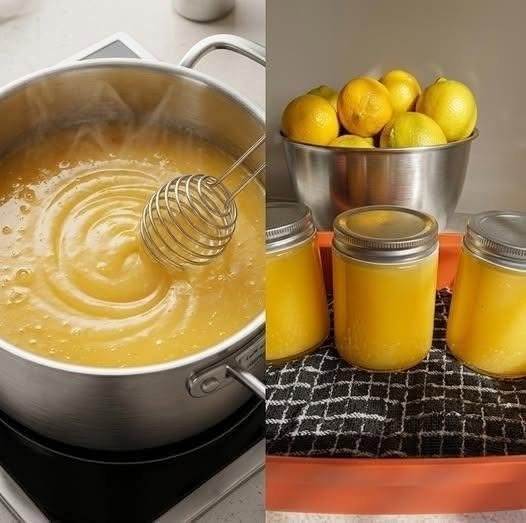
Homemade lemon curd is creamy, silky, rich, and intensely lemony, with just the right balance between sweetness and acidity. The butter gives it a luxurious texture while the fresh lemon juice and zest provide a bright flavor.
Once you master the gentle cooking technique, lemon curd is surprisingly easy to make. It is one of those recipes that can turn simple ingredients into something that feels incredibly special.
Keep a jar in the refrigerator and use it to brighten everything from morning toast to elaborate cakes. Whether you’re making a classic lemon tart, filling cupcakes, topping pancakes, or simply eating a spoonful straight from the jar, this homemade lemon curd is a versatile kitchen staple worth making again and again.

