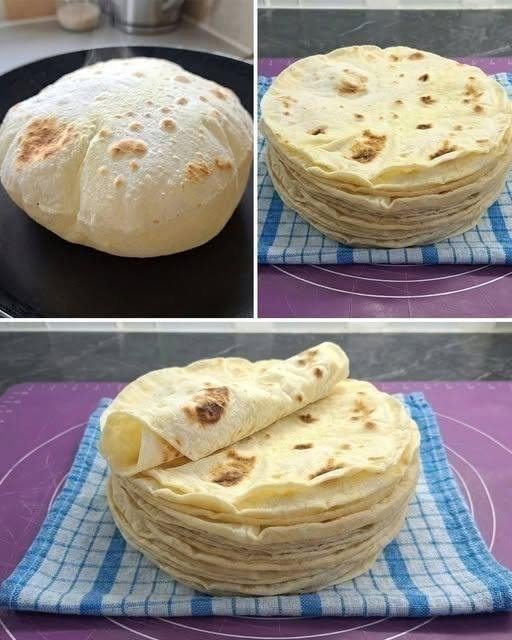
Ingredients
For approximately 10–12 tortillas, you will need:
- 200 g all-purpose flour
- 100 g active sourdough starter or sourdough discard
- 60–80 g warm water
- 30 g melted butter, lard, or neutral oil
- 5 g fine salt
- 1 teaspoon honey or sugar, optional
The amount of water can vary depending on the flour and the consistency of your sourdough starter. Begin with 60 g and add more gradually if the dough feels too dry.
For the softest tortillas, use a flour with moderate protein content. All-purpose flour works very well, but you can also substitute a portion with whole-wheat flour for a more rustic tortilla.
Step 1: Mix the Dough
Place the flour and salt in a large mixing bowl.
Add the sourdough starter, melted butter or oil, and honey if using.
Begin mixing while gradually adding the warm water.
Use your hands, a wooden spoon, or a dough whisk to bring everything together.
The dough should be soft and slightly tacky but should not be excessively sticky.
If the dough feels dry or crumbly, add another teaspoon of water at a time until it comes together.
If it feels very sticky, allow it to rest for several minutes before adding additional flour. Sometimes the flour simply needs time to absorb the liquid.
Step 2: Knead the Dough
Turn the dough onto a lightly floured surface.
Knead it gently for approximately 3–5 minutes.
You do not need to develop the same strong gluten structure required for a loaf of sourdough bread. The goal is simply to create a smooth, cohesive dough.
Once the dough feels soft and elastic, form it into a ball.
Place it back into the bowl and cover it with a clean towel or plastic wrap.
Step 3: Ferment the Dough
Allow the dough to rest at room temperature for approximately 4–8 hours.
The exact time depends on the strength of your starter and the temperature of your kitchen.
Because this is a relatively low-hydration dough, you may not see dramatic expansion. Instead, look for a slightly softer texture and a pleasant fermented aroma.
For a stronger sourdough flavor, you can refrigerate the dough overnight.
If using sourdough discard that is not very active, the tortillas can still be made, but they may not rise or ferment significantly. The discard will still contribute flavor.
Step 4: Divide the Dough
Once the dough has fermented, place it on your work surface.
Divide it into 10–12 equal portions.
For medium tortillas, portions of approximately 35–45 g work well.
Roll each portion into a smooth ball.
Place the dough balls on a plate or tray and cover them with a clean towel.
Let them rest for another 20–30 minutes.
This short resting period is important because it relaxes the gluten, making the dough much easier to roll.
If you skip this step, the tortillas may repeatedly shrink back while you are trying to flatten them.
Step 5: Roll the Tortillas
Lightly flour your work surface.
Take one dough ball and flatten it gently with your palm.
Using a rolling pin, roll from the center outward, rotating the dough as you go.
Continue rolling until the tortilla is thin and approximately 18–20 cm (7–8 inches) in diameter.
Try to keep the thickness as even as possible.
If the dough springs back, stop rolling and let it rest for another 5–10 minutes before trying again.
Avoid using too much flour during rolling because excess flour can burn in the pan and make the tortillas dry.
Step 6: Heat the Skillet
Place a large cast-iron or non-stick skillet over medium-high heat.
You do not need to add oil.
Allow the skillet to become properly hot before cooking the first tortilla.
A hot skillet helps the tortilla cook quickly and develop attractive golden-brown spots without drying it out.
Step 7: Cook the Tortillas
Place one rolled tortilla onto the hot skillet.
Cook for approximately 30–60 seconds, or until small bubbles begin to appear and golden-brown spots develop underneath.
Flip the tortilla.
Cook the second side for another 20–40 seconds.
You may see the tortilla puff up slightly. This is a good sign.
Avoid cooking the tortillas for too long. Overcooking is one of the most common reasons homemade tortillas become stiff and brittle.
Once cooked, transfer the tortilla immediately to a clean kitchen towel.
Cover it with the towel to trap steam and keep it soft.
Continue cooking the remaining tortillas.
Step 8: Keep Them Soft
As each tortilla comes off the skillet, stack it underneath the previous tortilla and keep the stack covered.
The trapped steam helps soften the tortillas and keeps them flexible.
If you are making a large batch, you can place the cooked tortillas inside a tortilla warmer or wrap the stack in a clean towel.
Do not leave freshly cooked tortillas exposed to air for long periods, as they can dry out quickly.
Troubleshooting
If your tortillas are too stiff, they were probably cooked for too long or the dough was too dry. Add slightly more water to the next batch and reduce cooking time.
If the tortillas tear easily, the dough may need more kneading or resting. Gluten needs time to relax and strengthen.
If the tortillas shrink while rolling, let the dough balls rest for another 10–15 minutes.
If the tortillas do not develop brown spots, your skillet may not be hot enough.
If the tortillas burn before cooking through, reduce the heat slightly.
Overnight Fermentation
For deeper flavor, prepare the dough in the evening and place it in the refrigerator after mixing.
Cover the bowl tightly and refrigerate overnight.
The next day, allow the dough to sit at room temperature for approximately 30–60 minutes before dividing it.
Shape, rest, roll, and cook as usual.
The longer fermentation can produce a more pronounced sourdough flavor and a pleasantly complex aroma.
Serving Ideas
Sourdough flour tortillas are incredibly versatile.
Use them to make:
- Chicken tacos
- Beef tacos
- Breakfast burritos
- Bean and cheese quesadillas
- Chicken wraps
- Vegetable fajitas
- Cheese quesadillas
- Breakfast wraps
- Homemade enchiladas
They are also delicious served warm with butter, scrambled eggs, avocado, salsa, or a simple sprinkle of salt.
Storage
Once completely cooled, store the tortillas in an airtight container or reusable bag.
They can generally be kept at room temperature for a couple of days.
For longer storage, refrigerate them or freeze them.
To freeze, place parchment paper between individual tortillas so they do not stick together. Put them in a freezer-safe bag and remove as many as needed.
To reheat, place a tortilla in a hot dry skillet for approximately 15–20 seconds per side. You can also microwave it briefly while covered with a slightly damp paper towel.
Final Tips
The key to soft sourdough tortillas is a dough that is hydrated enough, properly rested, and not overcooked.
Do not worry if your first few tortillas are not perfectly round. Homemade tortillas are often a little irregular, and that is part of their charm.
The more you make them, the easier it becomes to judge the dough consistency and rolling technique.
Once you get comfortable with the basic recipe, you can experiment with whole-wheat flour, herbs, roasted garlic, chili powder, or other seasonings.
These sourdough flour tortillas are an excellent way to use sourdough starter while creating something genuinely useful and delicious. They are soft enough to fold without cracking, sturdy enough for generous fillings, and flavorful enough to eat straight from the skillet.

